Saturday, June 7, 2014

Viagra for Skateboarders

 'An erection is like the theory of relativity - the more you think about it, the harder it gets.' 
Author Unknown

'And Adam Knew Eve...' (Genesis)
Why does the Bible use 'knowing' as a reference to the sexual act? 
Because sexuality hinges on awareness and focussed thinking. 
Chassidic Commentary 

What are the core features of sexuality?

1. Bonding forged through strong pleasure;
2. Reciprocity whereby giving and receiving pleasure become simultaneous;
3. Revelation of a deep part of oneself, be it in the form of an orgasm or the transmission of one's genetic code;
4. Creativity effected through the blending of two genetic codes.

According to a basic principle of Kabbalah, Hitkallelut, inter-inclusion, where every human psychic force is seen to contain all others, the sexual dynamic is visible at every level of the psyche:

In the realm of thought it brings us into a pleasurable bond with subject matter and rouses the creative mind to flow and combine with the subject matter to yield a personal and unique conception of it.

At the emotional level it allows us to forge a delightful bond with another which heightens our awareness and sensitivity to their person and cultivates authentic emotional exchange.

It also affords the body a heightened responsiveness to stimuli. When dancing to music, for instance, one may bond with the music so profoundly that the body locks into and moves with it automatically.

Interestingly, sexuality and thinking are tightly bound. This holds true despite the positioning of the head and genitals at opposite ends of the body and irrespective of their clashing natures wherein thinking accommodates multiple alternatives, order, and high levels of abstraction - even transcendence - while sexual energy pulls one into a singular focus involving physical bodily pleasure.

The strong link between sexual energy and thinking is visible in that while most external body parts can be activated and controlled directly by an assertion of will, the genitals are less compliant, requiring  something additional for activation: sustained thought about the beautiful and desirable aspects of an object. Will your hand, leg or eye lid to move and you get a near instant response. The same can't be said about the genitals. (So calling the male organ, 'Willy', as some do, really makes no sense!)

At all levels, such focused thinking fortifies intimate bonding while distraction - due to fear, other enticing opportunities and the like - diminishes it.

A skater's bond with his board is quite sexual. It's forged out of pleasure, involves simultaneous devotion and gratification and evokes both deep seated euphoria and creativity. The ability to consistently kindle and sustain a genuine desire to skate is thus an important part of the activity.

So what can one with waining inspiration do to re-activate, strengthen or disencumber their bond with  their board? In light of the above, here are a few basic suggestions:

a. Contemplate the beauty and elegance of skateboarding or specific skateboarding tricks (watching skateboarding DVD's can help);
b. Recall the satisfaction one gains when mastering a new trick;
c. Set goals in the mastery of tricks (since sexual energy entails a desire to culminate);
d. Improve one's ability to focus the mind in general;
e. Approach skating with a relaxed playful attitude so that one's spontaneous and creative self has the freedom to emerge...  


Monday, February 10, 2014

Hear O' humanity: the board and the brain: the board and the brain are ONE!!!

 Man has two means to succeed in life: education and physical activity. 
Not separately, one for the soul and one for the body, but in conjunction. Only then can he perfect himself.
-PLATO.

'Outside a dog, a book is a man's best friend; inside a dog, it's too dark to read!'
- Groucho Marx

If your brain is bored, get a board for your brain!
 - Dovid Tsap

'Learning' and 'action' are interdependent; genuine success at either requires input from both.

In Judaism, typically at sunrise, men wear two leather boxes containing scriptures that declare Divine Unity. The first goes on the left bicep; the second, between the eyes, just above the hairline. One binds them to oneself with leather straps, hence their name, 'Tefillin', denoting a 'bonding with God' - a bonding of body, as signified by the box on the arm, and a bonding of mind, as represented by the box on the head.

One puts on the arm Tefilin first to signify that only through faith-based action does the mind's door open to Heaven's mysteries. Conversely, one removes the head Tefilin first to indicate that insight within the mind's eye ought to flow into body movement - if it's to be integrated into one's life and bring benefit to the world.

In recent times, science has revealed some astonishing connections between body movement and success in the classroom. Some of the following facts were utter taboo in the scientific community of only half a century ago:


1. Balancing board and brain:

The brain contains various chemicals which influence thinking and mood. Serotonin helps keep brain activity under control and regulates mood and impulsiveness; Nor-epinephrine amplifies signals influencing attention and motivation; Dopamine affects smoothness of movement and a sense of satisfaction. 
Most psychiatric prescription drugs target these brain chemicals. Zoloft, alongside most current anti-depressants, influences Serotonin; Ritalin, an Amphetamine used to control ADHD, increases levels of Dopamine at the brain's fore.

Exercise has proved more effective than Zoloft at increasing Serotonin levels! More importantly, exercise balances the assortment of brain chemicals in their optimal and desired proportions. According to this, an early morning skate session can prepare a student's brain with the right balance of neurotransmitters - brain chemicals - thus setting the stage for high performance study sessions.


2. Hear O' humanity: the board and the brain: the board and the brain are ONE!!!


The Cerebellum, a lower back part of the brain involved in the co-ordination of movement, has been shown to not only co-ordinate the movements of the body but also the movements involved in the thinking process: sequencing of thoughts, shifting smoothly from one idea to the next, etc. These are coordinated by the Cerebellum as are the sequencing of steps in the execution of a Kickflip or a 360 Degree No-Comply.

In exercising the cerebellum for the sophisticated co-ordination required in skateboarding, one not only warms it up for class learning but also develops new patterns and sequences of movement in the arena of thought itself!


3. "And the L-rd said, 'Let US make Adam...'"


A medical dye injected into the bloodstream to highlight areas in the body where cells are rapidly multiplying (used to detect/control cancer) was surprisingly found in the hippocampus, an are of the brain central in learning and memory formation. Which cells proliferate in the hippocampus? Stem cells! Cells that can form into any cell of the human body and which are essential if any real learning - which involves the creation of new neural circuitry and patterns - is to be had. 

The amount of Stem Cells generated is strongly related to the amount a person exercises! Moreover, the more complex the exercises, the more stem cells are generated in order to allow the individual to learn or succeed at the new movements!

But the production of more Stem Cells in the hippocampus, on its own, is insufficient for learning to take place. The cells must be integrated into the neurological circuitry already existing in the brain by using them during study and deep thinking or problem solving. Otherwise the newborn cells don't have what to attach to and wither!


The process has been dubbed 'Neorogenesis' (bloody love it!) and explains why in reference to Adam, God said in the plural, 'Let US make Adam...!' As Neurogenesis reveals, we are co-creators with G-d in our own creation on an ongoing basis. By skateboarding before classes and then applying our brains during classes we constantly re-create and transform ourselves. 

Yes, it is we, and only we, that can transform our 'bird-brains' into 'board-brains!'         


Wednesday, January 15, 2014

Skateboarding: What's Love Got to Do With It?


What does love have to do with skateboarding?

Intrinsically, nothing and everything:

NOTHING - in the absence of skateboarding love continues to exist, just as it exists independently of all other activities aside the act of loving itself.

EVERYTHING - without a love of skateboarding people wouldn't skate, or at least not creatively and adventurously.

Ultimately, all forms of love spring from 'self-love' as the line 'Love your friend as you love yourself' suggests. But what is self-love?

Love for self springs from an awareness that one is a manifestation of God, a branch of the Tree of Life, formed with absolute attention to fine detail and a precision that utterly defies human comprehension.     

With self-love, one ceases seeking love and approval from others and liberates his mind to experience skateboarding sensually; as an art-form and medium for soulful expression.

With all embracing self-love one becomes a robust organic whole rather than comprising of many vulnerable parts or components and injects his entire being into every maneuver. 

Love fosters devotion to the object of love and draws one to focus their attention to fine detail. Love thus engenders a skating style that's smooth, stylish, and sophisticated.

Sometimes we collide with a soul so unconditionally loving that our self-love is ignited and fanned, instantly transforming our skateboarding into as newfound an experience as the love itself.

Here, love is a cocoon that allows one to free himself of his shell like inhibitions and to skate as an extension of his core - his unique psychic fingerprint...  

Wednesday, October 30, 2013

Clip: Through the Eyes of a skateboarding Rabbi.29.10.2013


Dovid Tsap, "The Skateboarding Rabbi" weaves together footage of his experiences at skateparks as part of his spiritual journey of self-discovery and transformation through skateboarding. Many more episodes are available. 

Thursday, October 10, 2013

'Face to Face' skateboarding II

  ...In essence, to come 'face to face' with a skatepark - or anything/anyone for that matter - is to identify the 'truth' of the thing and to adapt to it. Otherwise one may end up 'back to back': injured, unable to land tricks, or failing to optimise skatepark obstacles. But what is 'truth'? Or, at any rate, how is it usually defined?
            
One definition of 'truth' is articulated by Correspondence Theory where a  statement is deemed true when it matches reality: I.e. If one points to a green patch of grass and says ‘the grass is green’ the statement is considered true; but if one says ‘the grass is blue’ or ‘the wheat is green’, it is false.[1]


Coherence Theory considers a statement true when it gels with the network of current knowledge about existence.[2] Thus, the statement 'Alexander the Great existed' is deemed true not because he actually existed – as in correspondence theory – but because it coheres with the claims of the vast majority of historians. 

Pragmatic Theory deems something true if it's of benefit to do so. A clock (or the belief that clocks exist) is true because it helps people catch trains on time. Truth is created when value is demonstrated.[4] 
              A tweaked pragmatic theory, Instrumentalism, sees 'a truth' as anything that helps one deal with an ever-changing world. A new condition such as puberty, adolescence,  job, marriage, children, relocation, illness, death, etc - bring challenges. Through effort and the required skills and resources, however, one commonly finds ways to manage - or even thrive - in the new condition. This is the instrumentalist's 'truth'. Truth isn't a static thing hiding in the cosmos until found, like a fact before it's proven; it's dynamic; a private or public dance with the vicissitudes of life.

Of course, an instrumentalist may use other definitions of truth as instruments to deal with life. One might make a statement (I.e. a hypothesis) about a park or one of its obstacles and then validate or falsify the statement through experimentation. Alternatively/additionally, one may research up to date books or watch trick tips to find an approach which is supported by current knowledge or widespread belief among the skateboarding community or other relevant pools of knowledge. Either strategy - and better both in conjunction - can help one find the 'instrument'  -  the truth - that allows one to skate 'face to face'...       


[1] Richards, T.J., The Language of Reason, Pergamon Press, 1978, pp.142-143; see also Nyberg, David, The Varnished Truth, University of Chicagi Press, USA, 1992, pp.35- 37
[2] Ibid pp.139-142; The Varnished Truth, 33-35
[4] Stumf, Samuel Enoch, Socrates to Sartre, McGraw-Hill, 1999, pp.360 - 362
[5] Ibid. pp.366-368

Tuesday, September 10, 2013

'Face to Face' skateboarding I

Recently, I returned to skate Prahran after almost 6 months and found myself failing to land many of the tricks that I casually land at my home park, St Kilda. It was as if I enthusiastically faced the park, interested to connect with it, but had it turn its back toward me. Soon into the session, however, I realised that the reverse was true: I had my back toward the park.
              
 Generally, we make sense of new events or objects in two ways:
 a) we draw on memories of similar past experiences or relevant information;
 b) we distinguish between our memories and the present experience.

 For example, when I arrived at Prahran, I immediately started to see the similarities between it and St Kilda. As a result, I skated its mini ramp, quarter pipe, and hip in pretty much the same way that I skate the St Kilda counterparts. After a while, however, I began to identify more and more differences between the two parks: size, surface texture, coping width, transition gradient, etc. This allowed me to fine tune my skating to the parameters of Prahran.   
          These two methods are akin to the face and back respectively. When one draws exclusively on similarities one only gains a relatively superficial view of  a park, seeing it primarily as a shadow of other parks one has skated. It's as though one faces the other, more frequented, parks while having his back toward the current one. In contrast, when one focuses on differences, one gains a more accurate perception of the current park, and really enters into it, viewing it face to face.

The irony is that one seems to feel more motivated and confident to skate a park when focusing on its similarities to other parks one's accustomed. In contrast, when one begins focusing on differences, confidence and excitement levels tend to wane. Hence it appears that the former relates to the face and the latter, the back. In truth however, this difference is on account of two facts:

  • 1. The perception of similarities between things comes quite spontaneously and effortlessly. Differences, however, usually need to be teased out through conscious effort. People are naturally inclined to lose some motivation when they discover that effort and work is needed to succeed.

  • 2. Similarities offer an often illusory sense of confidence. Differences, however, sap confidence levels as they reveal that one may still lack the skills to effectively skate the present park.
This explains why I initially felt as though I was facing the park while it had its back toward me. I mistook the excitement and false confidence based primarily on similarities to be a sign that I'm doing my best to be in sync with the park. Ultimately, however, its only when one puts in the extra effort to differentiate that one can adapt one's skating to the new park and ultimately come into a real close range - face to face- relationship with it - something every skater, I believe, wants... 


Monday, July 29, 2013

Monday, May 20, 2013

Street Dreams


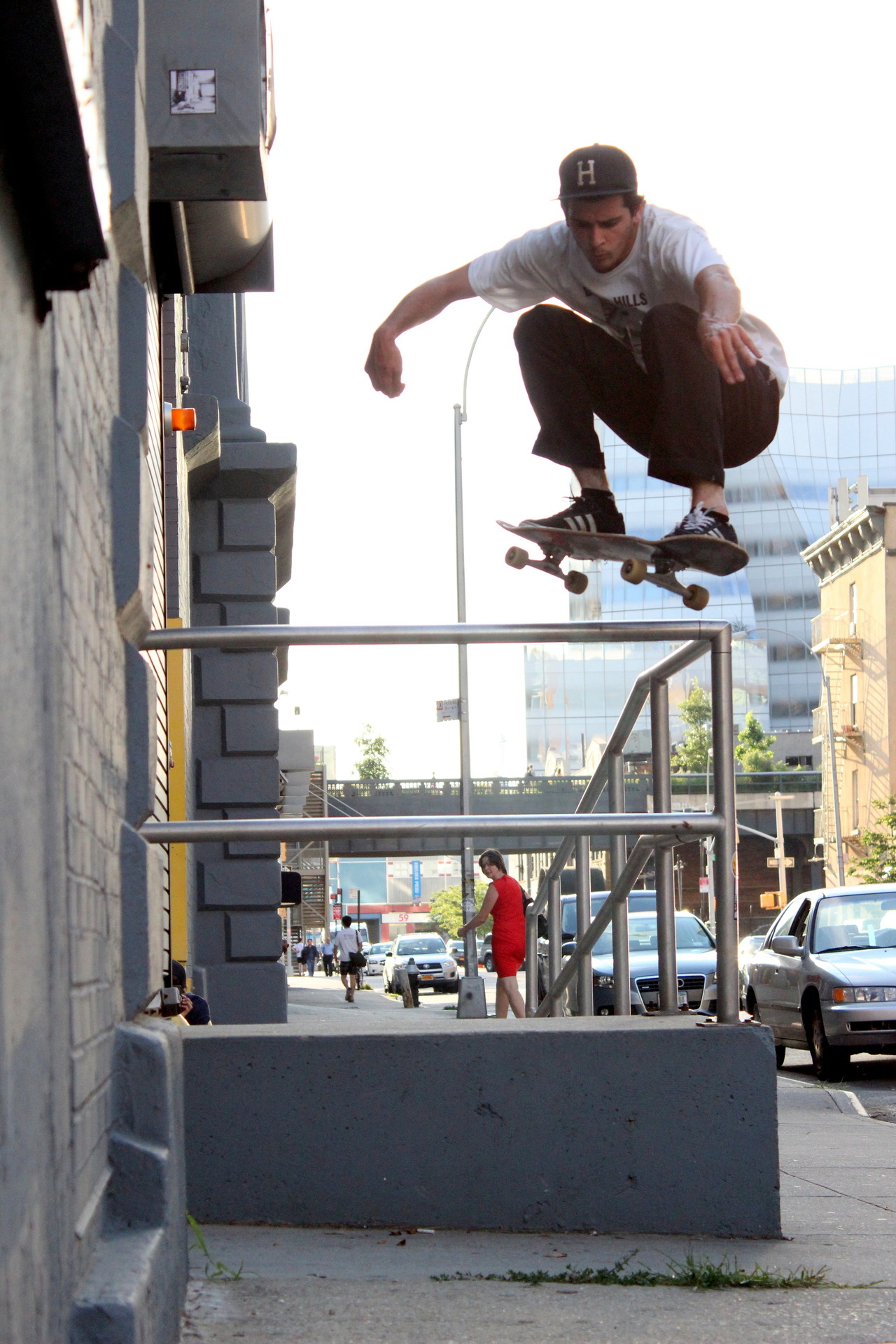
Regardless of the available number and quality of skate parks, skateboarders seem compelled to skate 'Street': to jump stairs and fire hydrants, slide down handrails, assail monuments, grind ledges, and ride walls. This has sparked ongoing confrontations between skaters and authorities, be they security guards, home owners, building managers, police officers or council members. What underlies this obsession with the ‘street’? Here are some possible motivations:

Availability: It may be suggested that travelling to a skate park takes time and one may not even be available in some places or at certain times. The street, however,  is readily available.

Along the way: Many skaters, especially non-drivers, use their skateboard for transport and typically have their boards with them much of the time. If they're already skating, surely they'll use the obstacles they encounter on their way.

Although these reasons may explain why people street-skate, they don't explain why skaters will leave a skate park in order to skate a street spot. The following explanations try to address this.

‘Stolen waters taste sweeter’: The Talmud explains that people have increased excitement when  benefiting from things prohibited to them. Skating a set of stairs in a high school complex may therefore be more exciting than skating a similar set at a skate park.  

Novelty: Skate parks are limited in the challenges and obstacles they offer. The 'Street' however, has relatively limitless opportunities for novelty, experimentation, and adventure.

Conquest: Many skaters are also graffiti artists or associate with people so inclined. 'Writers', as they're called, spread their signature -‘tag’ - in order to make a reputation for themselves in the underground culture and in order to feel that they've 'conquered' a place by signing it. Many skaters enjoy a similar attitude: knowing that skate spots tend to trigger skaters to recall the tricks landed in those spots, he leaves invisible traces of his artwork in many different places. He may also feel that he's conquered much territory.     

Living 'out of the box': There's something special about viewing and using objects in unconventional ways, especially in ways unintended by the designers. It’s as if one becomes a co-creator of the object. Thus, when Marcel Duchamp entered a urinal in an art exhibition (which he called ‘Fountain’) rather than creating anything new, he merely reinterpreted a ready-made item. Still, this opened people’s eyes to the beauty and art in even the basest objects. Along these lines, skaters may have fun revealing the artistic potential of otherwise ordinary street objects.  

Being real:  Whether aware of it or not, most people desire to live and thrive in the ‘real world’. To confront reality as it is without escaping into the comforts of fiction and fantasy. In this way, one validates himself as being real.
When skating in a skate park, a skater feels that he is escaping from the real world, entering into a space which is designed for skateboarding, where the ramps, ledges, handrails, stairs, etc., are not real but artificial – in a sense, fictional. The stairs don’t really lead anywhere, one walks up them in order to jump down them. The hand rail is not for holding onto when using stairs, it was made for grinding and boardsliding.
As long as a skater feels he is not skating in the real world, he feels he is escaping from it and thus not being real. This is why many skaters see the skate park as a preparation for street skating: for them, it amounts to flying lessons on a simulator in preparation for actual flight.         

Check out this clip of some New York Street Skating:
  

Thursday, April 4, 2013

Wednesday, February 13, 2013

Pascal: Feeling Groovy


I once read a book which explained some of the Hippy slang terms of the 60's and 70's. 'Groovy' was the word that struck me most. Groovy, the book states, implies that as a needle in a record groove enables one to hear music, when one's awareness is completely in the moment - the groove - one experiences reality in the richest ways.

There is one skateboarder who, to me, personifies the notion of 'groovy': Pascal Leniston. When Pascal skates, he seems completely absorbed in the experience. He doesn't grapple with his board, attempt to impress others; nor is he striving to become a pro. Rather, when he skates he reminds me of a young child playing with a toy, relating to the world in a pure and simple way.

When Pascal fails to land a trick, he usually smiles as if to suggest, 'Hey, that was fun too!' And, when he relates some of the amazing tricks he has performed, he stresses how much fun he had performing them rather than drawing attention to his skills or even the 'gnarliness' of the trick.


Pascal's playful way of skating is also visible in his tendency to bring old school tricks which, as relics, are seldom seen, and seasoning them with a contemporary flavor. (In the clip below, he performs an 'Underflip' off a ledge and onto a ramp.) He also appears to enjoy stretching skate park 'boundaries' for the sheer joy of it. For instance, he may use obstacles in unexpected ways, or literally, skate beyond the officially designated skate park limits. (In the clip, he grinds not only the formal skate park ledge but continues on to the narrow wooden barrier.)


I once overheard him talking to a few kids at Prahran Skate Park. He was telling them that he remembers being like them, skating all day and dreaming about skating at night. Though he was describing their purity of being and their innocence, he was doing so with such vitality and feeling that it was obvious that a spark of that innocence still glows strongly within him. To me, this was clear testimony, from Pascal's own mouth, that his amazing skateboarding style is largely inspired by sheer fun and play. 
           
                                                                                                         
                               Pascal Shredding Prahran (Pascal appears at: 1:21)


Tuesday, January 15, 2013

Street Dreams


     Regardless of the number and quality of skate parks available, skateboarders have a compelling need to skate the street: to jump stairs and fire hydrants, slide down handrails, assail monuments, grind ledges, and ride walls. This has sparked ongoing confrontations between skaters and authorities: security guards, home owners, police officers, and council members. What underlies this obsession with the ‘street’? Here are several possible clues:

 
1. Availability: It may be suggested that travelling to a skate park takes time and one may not even be available in some places or at certain times, such as at nights. The streets, however, are readily available. 


     2. Incidentally: Many skaters, especially those that don’t yet drive, use their skateboard for transport and typically have their boards with them much of the time. If they are already skating, surely they will use the obstacles that come their way to perform tricks on and have some fun.
 
 However, though these first two explanations may be real reasons why people sometimes street skate, they fail to explain why skateboarders will leave a skate park in order to skate a street spot. The following explanations attempt to address this.
  
3. ‘Stolen water tastes sweeter’: The Talmud explains that people tend to have exciting pleasure when they benefit from things normally prohibited to them. Skateboarding a set of stairs in a shopping complex may therefore be more exciting than skateboarding the same sort of stairs at a skate park.  

     4. Novelty:Skate parks are limited in the challenges and obstacles they offer. The street however, has relatively limitless opportunities for novelty, experimentation, and adventure.

        5. Conquest: Many skateboarders are also graffiti writers/artists or associate with people so inclined. ‘Writers’, as they are called, are obsessed with spreading their name – ‘tag’ – throughout the graffiti world; they seek recognition and reputation. They also feel that they conquer and take ownership of a place simply by labeling it with their signature or artwork.

Many skateboarders have a similar attitude in the sphere of skateboarding. By skating all sorts of difficult street spots around his city, a skater may feel that other skaters who arrive at that spot will recall how he did such and such a ‘gnarly’ trick there. He leaves his invisible artwork for passersby to appreciate him by. Alternatively, he may feel as though he partly ‘owns’ the place that he skated, after all, he did conquer it.      

     6.  Living out of the box:  There is a very special feeling when one can view and utilize objects in unconventional ways. That is, in a way that they were not intended to be used by their inventors. It’s as if one becomes a co-creator by reinterpreting the object. Thus, when Marcel Duchamp entered a urinal in an art exhibition (which he called ‘Fountain’) he did not create anything new but merely re-framed a mundane object. Yet, this was deemed artistic and opened people’s eyes to the beauty inherent even in the basest of objects.

Along these lines, skaters have incredible pleasure in perceiving and revealing the artistic potential that otherwise lies hidden within banal street objects.  

7.  Being real:All people, whether conscious of it or not, have a need to enter the arena of the ‘real world’ and thrive there; to confront reality as it is, without escaping into the comforts of fiction and fantasy. In this way, one validates himself as being real. When skating in a skate park, a skater feels that he is escaping from the real world, entering into a space which is designed for skateboarding, where the ramps, ledges, handrails, stairs, etc, are not real but artificial and simulated – in a sense, fictional. The stairs don’t really lead anywhere, one walks up them in order to jump down them. The hand rail is not for holding onto when using stairs, it was made for grinding and boardsliding.
                                                                                                                   
As long as a skater feels he is not skating in the real world, he feels he is escaping from it and thus not being real. This is why many skaters see the skate park as a preparation for street skating: for them, it amounts to flying lessons on a simulator in preparation for actual flight.            
       

Followers